
Postdoc or not? How to decide after your PhD
In brief
A postdoc can be the right next step if you want an academic research career or if a particular career path genuinely requires postdoctoral experience. It may also help you develop a new specialisation, build an international network or move to another country. However, a postdoc is rarely the best default option simply because you are uncertain what to do after your PhD. The value depends less on the title “postdoc” than on what the specific position adds to your skills, independence and future opportunities.
What is a postdoc?
A postdoc is a temporary research position, usually at a university or research institute, undertaken after completing a doctorate. It doesn’t provide an additional degree. For researchers aiming to lead their own academic research group, one or more postdoctoral positions are normally an important step towards developing the required scientific independence. In almost all cases, you need a completed PhD or equivalent doctorate.
Companies also sometimes offer postdoctoral positions. These are generally hands-on research roles and do not necessarily provide the same opportunities to develop an independent research profile as an academic postdoc.
Should I do a postdoc after my PhD?
This is a fundamental question you should ask yourself before starting to apply for jobs. We believe that in most cases, it is relatively easy to answer this question. Ask yourself what you would like to do in the future.
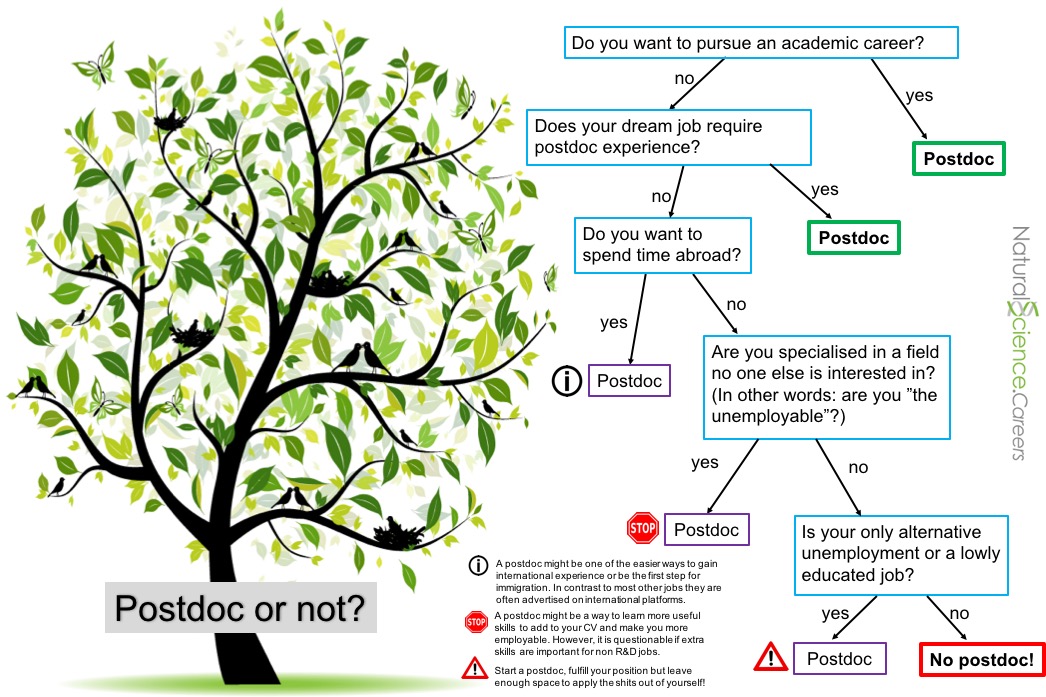
Would you like to pursue a career as a researcher in academia, and could you imagine running your own research group in the future? In other words, do you want to have a career in science? – Do a postdoc!
Can a postdoc make sense if I don’t plan an academic career?
If your target position requires it: Does your future career plan or dream job genuinely require postdoctoral experience? If so, a postdoc may be sensible. Before deciding, speak to people already working in your target field to find out whether it is a firm requirement or whether other forms of experience would be more valuable.
If you want to expand your expertise: A postdoc can help you enter a new research field or add particular methods and expertise to your profile. However, outside academia, broader professional experience may sometimes be valued more highly than further academic specialisation.
If you want to move abroad: A postdoc can offer a relatively accessible route into another country. The international character of academia may also make it easier to establish professional and social networks in a new location.
The important question in all three cases is whether the postdoc serves a deliberate purpose. Many researchers accept a postdoctoral position because it is readily available or because they have not yet found an alternative. This can gradually turn into a long postdoctoral phase that they never actively chose.
If uncertainty is the main reason you are considering a postdoc, it may help to step back and examine your priorities, transferable skills and possible career paths first. Our career resources provide starting points for this reflection.
Unfortunately, many scientists sign up for a postdoctoral research position for the “wrong” reasons and slip into long postdoc phases without actively choosing. Two reasons you hear often are that they struggle to find a job outside academia or that they took the easy route and accepted the postdoc position offered after their PhD.
If you already know that you want to leave academic research, an additional postdoc should have a clearly defined purpose. Otherwise, it may postpone the development of experience that employers outside academia value more directly. The difficulty is not simply that you become “overqualified”. Rather, you may have to work harder to explain how increasingly specialised academic experience transfers to the role you want. A long postdoctoral phase can also make a career change feel psychologically more difficult, even when it remains entirely possible.
Is a postdoc a good temporary or “parking” position?
Of course, you could use a postdoc as a “parking position” to apply for other jobs. The challenge is keeping enough time free for these applications while still fulfilling your responsibilities as a postdoc. The advantage here is not only that you are not pressed for time and are in a comfortable situation, but also that it is easier to negotiate when you have a position. When you are unemployed, it is hard to ask for a high salary unless you know alternatives are lined up for you. If (financially) possible, we recommend that you stay calm and take the time to apply for jobs until you find the job you really want to do!
Can I return to academia after leaving?
Are you reluctant to leave academia because you fear that there may be no way back? Returning can be challenging, particularly after several years outside academic research, but it is not impossible. Experience gained in industry, government or another sector can add valuable perspectives, especially in collaborative and application-oriented research.
The central challenge is maintaining or rebuilding a convincing research profile. If returning to academia is a serious possibility, consider how you could stay connected to research, publications and relevant professional networks while working elsewhere.
Further reading and alternatives to a postdoc
We explored the risks of drifting into a postdoctoral position without a clear goal in our Naturejobs article The autopilot postdoc, written with David Giltner of TurningScience.
If you are considering other directions after your PhD, explore our overview of (Alternative) career options and our other Career resources.
If you are weighing academic research against a company-based career, our article PhD in Industry provides another perspective on research inside and outside academia.
Supporting PhD candidates with this career decision
The question “Postdoc or not?” is one of the decisions explored in our PhD! And, next? workshop. It helps PhD candidates examine their interests, skills and career options before choosing their next step. Graduate schools, universities, and research institutions can book the workshop.
The checklist. Before accepting a postdoc, ask yourself:
- What concrete career goal would this postdoc help me reach?
- Does that career genuinely require postdoctoral experience?
- Which new skills, methods or areas of expertise would I gain?
- Would I develop greater research independence—or mainly continue doing similar work?
- What is the supervisor’s record of supporting postdocs’ careers?
- Where have previous postdocs from the group gone afterwards?
- The opportunity loss: What alternatives would I postpone by taking this position?
- How much time would remain for career exploration and applications while working as a postdoc?
- Do the salary, contract length, location and personal circumstances work for me?
- What would be my planned exit point if the position did not lead towards my goals?